

Meowdoku Guide: Find Your Next Cat Without Guessing
Learn a repeatable elimination method for Meowdoku, avoid diagonal-rule mistakes, and see how the same planning habit applies to Arrow Puzzle.
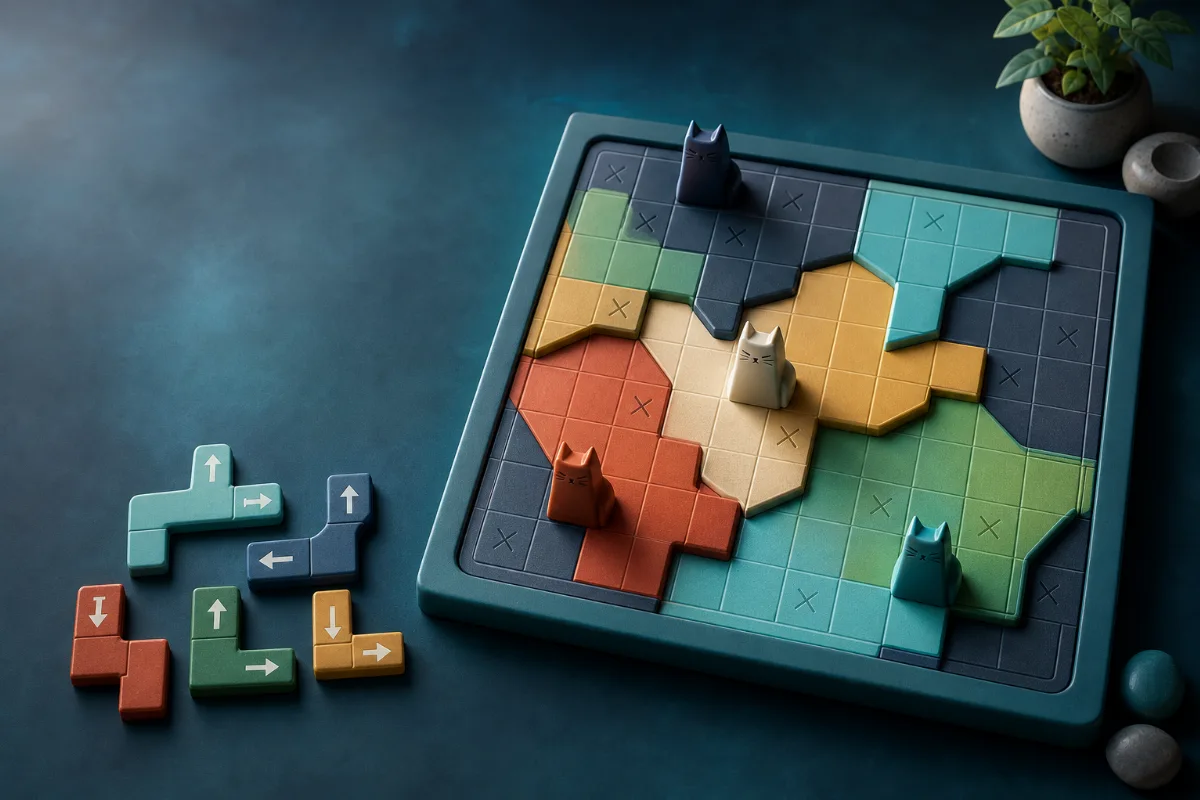
When a Meowdoku board looks stuck, choosing a plausible square is tempting. A better first step is to identify squares that cannot contain a cat, then look for what remains. This guide turns the game’s placement rules into a repeatable deduction loop, with an illustrative example you can follow without needing a particular level. The aim is to find a justified next move instead of making a guess you will have to undo. The deductions below are editorial explanations of the rules, and the worked board example is illustrative.
1. Check all four constraints before placing a cat
Meowdoku requires exactly one cat in each row, each column, and each colored region. Cats also cannot touch, including diagonally. A square is legal only when it satisfies every condition together. Being the best-looking square in a region is not enough if it shares a column with a confirmed cat.
Separate the two kinds of distance restriction. Sharing a row or column is forbidden anywhere along that line. Diagonal contact is forbidden only between neighboring squares. Two cats farther apart on the same diagonal are not disallowed by that fact alone. Do not apply the full diagonal restriction used by chess queens.
Use a single click or tap for marking or removing an X, and a double-click or double-tap for placing or revealing a cat. Check the in-game instructions before committing a placement. Listed touch controls alone do not establish reliable compatibility on every mobile browser.
Sources: Meowdoku — GameHubVerse Play Queens game on LinkedIn | LinkedIn Help
2. Use the same elimination loop after every confirmed cat
Once a cat is logically confirmed, mark the other squares in its row, column, and colored region as impossible. Then check its neighboring squares, especially the diagonals: those can belong to different rows, columns, and regions while still touching the cat.
Next, scan every unfinished row, column, and region for a single remaining legal square. If a unit needs one cat and only one square can still hold it, that placement is forced. After placing it, repeat the exclusion process before searching elsewhere. One placement can create another, but only if you carry its consequences through the board.
For example, suppose a row has three candidates. One shares a column with a confirmed cat, and another touches a confirmed cat diagonally. The third is forced if it satisfies the remaining constraints. Keep a reason for every X; an unsupported exclusion can make a later placement look certain when it is not.
Sources: Meowdoku — GameHubVerse
3. When singles disappear, look for a region confined to one line
You do not always need to know a cat’s exact square to learn something useful. If every remaining candidate in one colored region lies in the same row, that region’s required cat must occupy that row somewhere. Consequently, no square outside that region in the same row can contain a cat.
The identical argument works for columns. If a region’s candidates all fall in one column, exclude that column’s squares outside the region. Then return to the single-candidate scan: these new exclusions may leave another row or region with only one option.
Apply this only after checking the entire region. A candidate around an irregular boundary can invalidate the deduction. Two attractive squares in one row are not enough; every other square in that region must already be impossible for a valid reason.
Sources: Meowdoku — GameHubVerse
4. Walk through an illustrative two-candidate example
This is an illustrative example, not an actual Meowdoku level. Imagine a colored region whose only remaining candidates are row 3, column 2 and row 3, column 3. You cannot yet choose between those squares. However, you do know that the region’s cat must be in row 3.
Now imagine a different region with only two candidates: row 3, column 5 and row 5, column 5. The first region already requires row 3’s single cat, so the second region cannot use row 3, column 5. Its cat is therefore forced into row 5, column 5.
That confirmed placement starts the ordinary loop again: exclude the rest of row 5, column 5, its region, and its touching neighbors. Notice what made progress possible: you used certainty about a row without pretending to know the first cat’s exact position.
Sources: Meowdoku — GameHubVerse
5. Audit your marks before reaching for a hint
If nothing follows, inspect the board rather than immediately adding another assumption. Check for missed diagonal neighbors, overlooked parts of colored regions, and exclusions based on distant diagonal alignment. Also ask whether any X came from a cat you merely suspected rather than proved.
An unfinished row, column, or region with no candidates signals a contradiction in your current reasoning or marks. Revisit the deductions that removed its last options. Do not keep building on that contradiction.
Meowdoku includes hints. Check the in-game explanation for what a hint reveals and whether using it has a cost. If you use one, compare the resulting information with your candidate marks. Finish each review with three questions: What is impossible? Which unit has one candidate? Is any region confined to one line?
Sources: Meowdoku — GameHubVerse
6. Carry the planning habit into Arrow Puzzle, not the cat rules
For a different application of planning before acting, GameHubVerse also lists Arrow Puzzle. Select arrows with a clear path in their pointing direction; blocked attempts can fail and cost a move. Before tapping, trace the whole exit path and identify what blocks it.
The transferable habit is checking constraints before committing an action. The rules themselves do not transfer: Arrow Puzzle has no documented one-per-row or colored-region requirement. In Meowdoku, prove where a cat must go; in Arrow Puzzle, verify which arrow can leave now. The useful connection is deliberate planning, even though the puzzles use different rules.
Sources: Arrow Puzzle — GameHubVerse
Try these games on GameHubVerse
Prepared with AI assistance using the linked sources and GameHubVerse catalogue. The banner is an editorial illustration, not a gameplay screenshot. Availability and features may change.